Serial number 20328

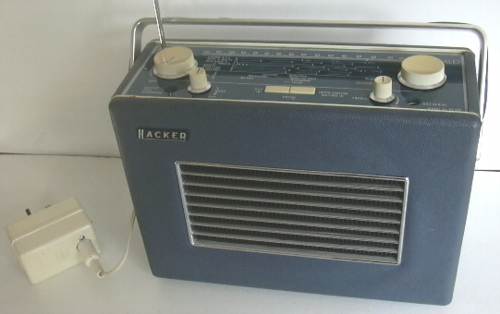
Portable Transistor radio Made by Hacker Radio Ltd, Maidenhead UK. The radio which was kindly given to me by Stephen Trilvas is housed in a blue leatherette covered wooden case and unusually is a VHF only receiver.
This is a high quality single band (88-101 mHz) radio with 13 transistors, treble and bass tone controls, sockets for a tape recorder and external aerial, automatic frequency control and inter station muting buttons. This radio is normally powered by two 9 volt PP9 batteries in series though as can be seen this one came with a power supply.
I understand that this model was first produced in 1969 but the date codes on two of the electrolytic capacitors indicate that they were made in 1967.
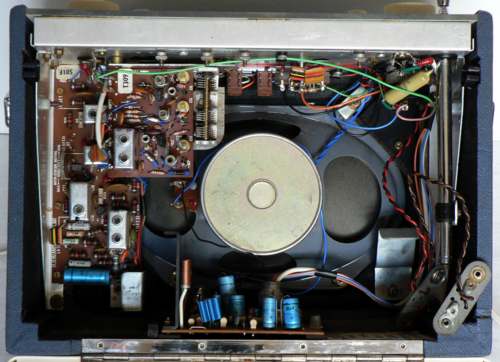
View of interior
Note the substantial loudspeaker and the two 9 volt batteries.
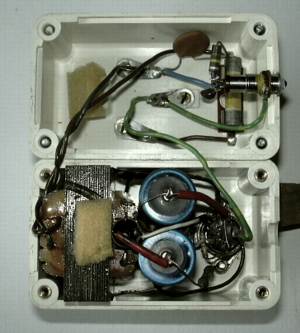
Interior of 9/18 volt power supply
"Adaptavolt model 918" manufactured by TRC providing 9 and 18 volts at 20 to 70 mA. The two core cable to the battery terminals in the radio is terminated with a multi pin DIN connector.
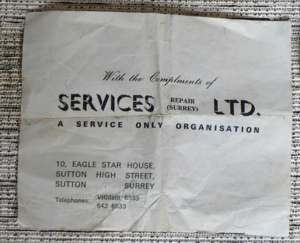
Found inside.
Stewart Kitch has sent me the following information about his career at Airmec which sheds an interesting light upon the manufacture of some Hacker radios.
I moved back to Somerset to work at Airmec at Seaton Devon, firstly as a "test improver". While "improving" I worked on valve test equipment such as their Signal generator 210 and wave analyzer 853, prior to a Racal take-over in about 1969. I then calibrated and repaired the test equipment, and saw some examples of this on your web site. At this time we also had a contract to build and test Hacker radios, such as the Herald, and I remember building a stereo record player using 2 of audio amps! We had 2 Test personnel; I tested all the instruments and the other guy did the Hacker Radios. As Racal expanded I ran a section that tested a range of "Racal Instruments" products which were largely frequency counters. Several other Racal companies ran our site, with more profit being made on military radios such as the 931X. I think I could still test one of those in my sleep!
Cellular radio then reared its head and we made the car "transportable" model, before making a few "almost portable" models. These were fairly troublesome, but Racal made a good profit and started Racal-Vodafone as it was then. We later made the most complicated 39D military radio and were waiting for the Bowman project which was eventually awarded to another company. Following rumours of a take-over by Tompson CSF, we were closed in 2000 and all made redundant, the factory being demolished a few weeks ago. Racal became Thales, but Vodafone continues.
I believe Airmec opened their second factory at Seaton in 1965 to make use of our cheaper labour! The "Banbury" was the first building, made of concrete panels and located on the site of the Southern Railway station which was not demolished until later (1969?) High Wycome remained the Head office and were always keen to tell us where we were going wrong! During a holiday last year, another couple joined us at our table who hailed from Wycome. I told her of Airmec and she said she worked there after leaving school as a typist, and knew several of the directors and staff including Fred Pears, who was in charge of Seaton. She started in the late 50's and left when her family arrived.
Besides the Hacker contract there was also a Motorola contract for car radio sub assemblies, which ceased soon after I arrived. Another "flop" was "Telefi", a small box which picked up the sound from your TV IF to feed into your Hi -fi for much better sound. They were constructed in nice wooden boxes - I still have loads of small wood screws that were used!
Thinking hard, I believe we made 2 models of Hacker Radios, but although one looked like the Herald, I'm sure that was not the name. It was a long time ago though.
B Wixon who worked for Airmec for 8 years until the merger with Racal Instruments for whom he worked for a further 3 years was interested to see that they later went on to test both Racal and Hacker products, presumably after the Airmec range was phased out. After starting in the Test Dept he transferred to the Service Dept eventually becoming Service Manager. He goes on to say that Airmec opened the Seaton factory to take advantage of a government scheme to take employment to such areas as the South West. Plans were made to transfer some of the staff from High Wycombe, but were probably shelved when the merger was mooted. He was also invited by Fred Pears to take over the running of the Test Dept there but declined after visiting the area. He says that Stewart Kitch was correct in that they did make several suggestions to them particularly with regard to testing, as they had more experience. Part of his job was to carry out pre-sales tests on the equipments from which some problems were found and he feels sure "they would have benefited from our experience".